Al-Zaman - Iraq Edition - Independent International Daily Arabic Newspaper
Al-Allaf owns the largest personal library in Iraq.
A century has passed since the emergence of a cultural treasure trove of thousands of titles owned by a seasoned academic.
Mosul - Samer Elias Saeed
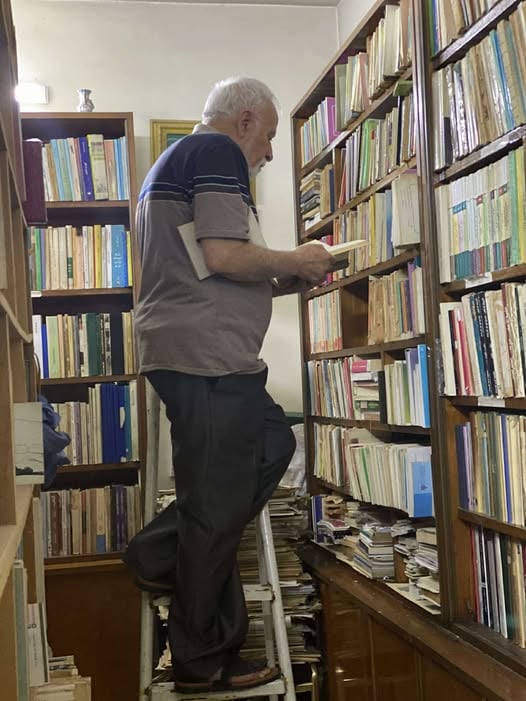
A few weeks ago, while browsing social media (Facebook), I was struck by a picture posted by Dr. Ibrahim Al-Allaf, in which he was climbing a staircase to look for a book in his well-stocked library. This prompted me to ask Al-Allaf for permission to talk about his library, which he has always talked about on his social media site, elaborating on the worlds of books it contains. In his answers, Al-Allaf pointed out to me that his library today occupies three rooms in his house in the Al-Nour neighborhood in the city of Mosul, Iraq .
Bookcases
My library is over eighty years old, which is also my age. I would say its origins date back to 1925, the year my father was born and developed an interest in reading, Quranic recitation, the Holy Quran, literature, and culture. The library has moved several times throughout Mosul. My first residence was in the Ras al-Kur neighborhood, then in the Imam Ibrahim neighborhood, then in the Shahr Suq neighborhood, then in the Andalus neighborhood, and finally in the Al-Nour neighborhood. Of course, I have bookshelves that are 50 years old, which I cherish and still keep. I also have a bookshelf in the Central Public Library of Nineveh Governorate, which is my personal collection and which I replenish from time to time. It is called the Ibrahim al-Allaf Library .
Regarding the first book, which represents the core of the library, Al-Allaf continued by saying that he inherited it from his father, may God have mercy on him, Khalil Ahmed Al-Hamid Al-Allaf. It was a modest library containing about 100 books. Among the most prominent things that Al-Allaf found in his father’s library were the works of Professor Mustafa Sadiq Al-Rafi’i, the great Egyptian writer 1880-1937, especially his book (Revelation of the Pen), which is in three parts and is originally literary articles that he wrote in the magazine (Al-Risala) of Professor Ahmed Hassan Al-Zayyat .
In my father's library, I also found—and this is according to Dr. Al-Allaf—the three-volume work by Professor Ahmed Amin, "The Dawn of Islam," and also the three-volume work "The History of Mosul" by the historian, writer, and novelist, Bishop Suleiman Al-Sayegh. These books are in my library, and I cherish and am proud of them, for they are among the things that have contributed to my cultural development over the past eighty years .
Regarding the number of books in his library, Al-Allaf replied that he hadn't conducted a census, but added that it occupied three rooms in his house and he believed it contained over 10,000 books. He also mentioned that his library contained approximately 500 theses and dissertations, in addition to journals. He possessed numerous issues of Iraqi and Arab academic and cultural journals, including the Egyptian journal "Al-Hilal," the Iraqi journal "Afaq Arabiya," the Iraqi journal "Al-Thaqafa Al-Jadeeda," the Kuwaiti journal "Al-Arabi," and the Mosul-Baghdad journal "Bayn Al-Nahrayn." He further mentioned a large number of Iraqi and Arab academic journals, such as "Al-Ustadh," "Al-Tarbiya Wal-Ilm," and "Adab Al-Rafidain . "
Regarding the sorting of books, sorting is often done by size, and by subject. I have a section for memoirs, a section for books on the history of contemporary Iraq, a section for books on Palestine, a section for books on Jordan, Syria, the Arabian Gulf, Orientalism, literature, religion, arts, books that deal with the Kurds and the Kurdish issue, books on the philosophy of history, books on philosophy, journalism, economics, arts, proverbs, poetry, novels, criticism, and so on .
Faculty
Regarding the time Al-Allaf spends in his library, he said, “I am now a retired professor, meaning I have retired after 50 years of service in schools and universities. The title of retired professor is granted to those who hold the rank of full professor but maintain academic activity beyond that and enjoy the same rights and privileges as a university faculty member. This means I dedicate myself—and I may not be exaggerating when I say I spend long hours—in my library and office in my modest home, reading, writing, and working on my Facebook page, my blog (Dr. Ibrahim Al-Allaf’s Blog), and my sub-site on (Al-Hiwar Al-Mutamaddin). Many people follow me .”
Regarding the methodology; the reading methodology is that I read and write. Of course, I only write based on what I read. Every day, as part of my daily mail, I receive books and publications gifted by their authors, and I write about them all, offering reviews and analyses. I consider this a kind of ethical obligation, as no book can reach me without me writing a review or analysis about it, except for what I deem unworthy of being written about, and this is a very rare occurrence. I practice cultural criticism, and I believe that this criticism is important because, firstly, it encourages writers, and secondly, it adds a kind of knowledge to readers, graduate students, and those interested .
Part of my reading method is that I record notes on books in a special notebook, writing with a pen. I don't leave out any notes about the author, and today I own hundreds of notebooks in which I record my notes about the author, the book, or about those who have written on this subject before.
Regarding my question about what rare and valuable books the library possesses, Al-Allaf replied, “By God, I do not know that precisely, and the reason is that what is rare to me is not rare to you. I have books that I consider rare, for example, everything written about my beloved city of Mosul . ”
I consider it rare. For example, Suleiman al-Saigh's book, "History of Mosul," printed in Egypt in the 1920s, is rare, as are the works of our professor, Saeed al-Diwaji, and so on. I have rare books on astronomy, philosophy, historical methodology, Durant's 59-volume "Story of Civilization," the works of Professor Abdul Razzaq al-Hassani, and the works of Professor Abbas al-Azzawi, in addition to Hassan Ibrahim Hassan's "History of Islam," and books related to Iraqi ministries, Iraqi tribes, and the Iraqi, Egyptian, and Syrian press, and so forth. Of course, I also have books in English by most of the foreign authors who have written on the history of modern Iraq .
Regarding the books he focuses on most, Al-Allaf said that he starts from several circles, the first being local history. He is interested in books about Mosul and other Iraqi and Arab cities, as well as provinces, governorates, villages, and districts. The second circle is Iraq, the third is the Arab world, the fourth is neighboring countries, and the fifth is the world at large. This is, of course, on political, economic, social, and cultural levels. He is interested in books on Ottoman history, books on the Ottoman-Persian conflict, and books on the history of contemporary Iraq. He has authored 70 books, the first of which he wrote and published in 1982 was about the emergence of the Arabic press in Mosul, and his latest book, published in 2025, is titled "A General Overview of Contemporary Iraqi History . "
Regarding unusual books with unexplored themes and meanings, Al-Allaf revealed that there are many such books, including those dealing with strange topics such as political assassinations, magic, dreams, stamps, money, historical intrigues, coups, violence, sectarianism, and sectarian conflict. He added, "I own books on everything related to our history and the history of others, and I always return to these books. There are strange factors behind historical events, and there are books that address what historians have neglected. I am interested in history and know its benefits and drawbacks, and I have written articles on all of this ."
I wrote about exclusion, uprooting, separation, expulsion, stripping of citizenship, bribery, and corruption in the history of contemporary Iraq and throughout its periods and eras. The intention is for us to learn a lesson and take heed, but as the German philosopher and historian Hegel says: “The lesson we learn from history is that we never learn .”
He describes the harshest days of the library that he went through, referring to the control of ISIS elements over my beloved city of Mosul from 2014-2017. I wrote and adhered to the slogan (your house is your grave) and I remained suffering, but I distanced myself from these elements. The reason, as my wife, Dr. Sanaa Abdullah Aziz Al-Tai, a historian specializing in Abbasid history, knows, is that if I had left, they would have seized my house and burned my library, meaning that they would have burned my soul and my history, and this is something I would never accept. I spoke about this when I went and found the central library of the University of Mosul burned, for wherever books are burned, people are burned, as they say .
Al-Allaf makes the library available to researchers and graduate students through a system he uses to provide this elite group with the books and resources they need. He says, "I have supervised a large number of graduate students, and we have completed outstanding theses and dissertations, praise be to God. My students today occupy ministerial positions, deanships of colleges, and are professors in universities and schools. I still provide consultations to researchers, graduate students, and those interested in various fields, both in Iraq and abroad. I photocopy some books and pages for them, and I advise and guide them. Many of my articles have been turned into theses and dissertations. I give many of them the books and resources I have. Sometimes I am surprised to find some books missing, and I remember that they are with so-and-so. I ask him to return them, and he apologizes, saying he is crazy to return them. I laugh and say to him, 'And who is crazy enough to lend a book?' We laugh, and that's the end of it. Imagine, I needed a book, so I asked the brother who borrowed it from me to photocopy a copy for me. I always say that the zakat of knowledge is its dissemination, and I ask everyone to read, for he who does not read stagnates . "


ليست هناك تعليقات:
إرسال تعليق